
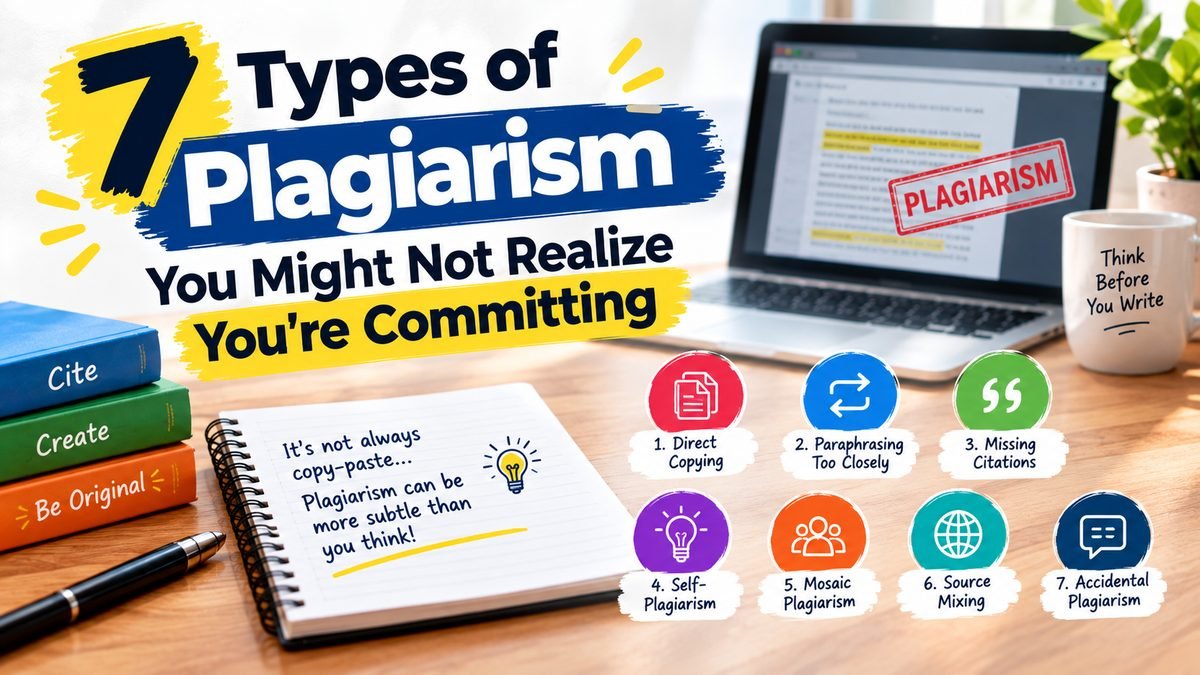
7 Types of Plagiarism Every Writer, Student, and Content Creator Must Understand
When most people hear the word "plagiarism," their minds instantly conjure up a vivid image: a dishonest student highlighting a Wikipedia entry, pressing Ctrl+C, pasting it into a term paper, and pretending they wrote it from scratch. While blatant copy-pasting certainly remains a frequent issue, it represents only the visible tip of a much larger intellectual iceberg. In reality, plagiarism manifests in numerous subtle, insidious forms—many of which occur without any malicious intent whatsoever.
In modern research, content marketing, and digital publishing, the line between legitimate inspiration and intellectual property infringement can become blurry. Whether you are an undergraduate working on a thesis, a freelance copywriter crafting web content, or an online publisher striving for Google AdSense monetization, understanding the nuances of duplicate content is essential. Algorithms, academic institutions, and search engines have evolved beyond simple string matching; today, they analyze syntactic structures, contextual flow, and research citations with remarkable precision.
To safeguard your academic integrity and professional reputation, you must familiarize yourself with the full spectrum of intellectual theft. Below is an exhaustive examination of the seven primary types of plagiarism, complete with real-world examples, detection mechanisms, and actionable prevention strategies.
1. Direct (Verbatim) Plagiarism
Direct plagiarism is the most traditional, obvious, and indefensible form of intellectual theft. It occurs when a writer lifts text word-for-word from an external source and embeds it into their own work without enclosing the passage in quotation marks and without naming or linking to the original author.
Why It Happens: Direct plagiarism typically stems from either deliberate dishonesty, desperate attempts to meet impossible deadlines, or sheer panic. Writers assume that obscure sources—such as paywalled academic journals, foreign language translations, or forgotten blogs—will go unnoticed by readers or instructors.
The Risk: This is the easiest type of duplicate content to catch. Automated similarity tools, including Turnitin, Copyscape, and Google's indexing crawlers, flag verbatim word strings almost instantly. In academia, it almost always leads to disciplinary action or expulsion; in digital publishing, it guarantees copyright strikes, DMCA takedown notices, and immediate AdSense rejections.
2. Mosaic Plagiarism (Patchwriting)
Also widely known as "patchwriting," mosaic plagiarism is a far more pervasive and deceptive practice. It occurs when a writer interweaves copied phrases, clauses, and key terms from a source directly into their own prose without fundamentally restructuring the sentences or using quotation marks.
Why It Happens: Mosaic plagiarism is rarely a premeditated attempt to cheat. Instead, it is the natural byproduct of hurried research. A writer copies a few sentences from a source into their scratchpad, opens a thesaurus, and substitutes every third or fourth word with a synonym while keeping the original grammatical skeleton untouched.
The Danger: Patchwriting gives the author a false sense of security. Because the text does not match the source word-for-word, the writer assumes it is "original." However, linguistic algorithms analyze syntactic cadence and grammatical dependency. If the skeleton of the sentence belongs to someone else, it remains a severe violation of intellectual property ethics.
3. Paraphrasing Plagiarism
Paraphrasing plagiarism occurs when a writer takes someone else’s unique argument, analytical model, data interpretation, or narrative arc and rewrites it in entirely different vocabulary, but completely fails to credit the originator of the concept.
The Misconception: Many writers operate under the mistaken belief that as long as every single word is changed, the text becomes completely their own. This is fundamentally untrue. Words are merely the vessel; the underlying idea, research finding, or theoretical framework is the actual intellectual property. If you replicate an author’s logical progression without attribution, you have committed paraphrasing plagiarism.
How to Avoid: Paraphrasing is encouraged when synthesizing research, but it must always be accompanied by an in-text citation, a parenthetical reference, or a natural contextual hyperlink (e.g., "As argued by Dr. Smith in his 2024 behavioural analysis...").
4. Self-Plagiarism (Text Recycling)
Self-plagiarism—frequently termed "text recycling"—occurs when an author reuses substantial portions of their own previously submitted, graded, or published material in a new assignment or article without permission or formal disclosure.
Why People Struggle With It: Writers often ask: "How can I steal from myself?" While it does not represent theft of another person's work, it violates the implicit agreement of original presentation.
- In Academia: Submitting a paper you previously wrote for a different class violates institutional honor codes, as degree requirements demand new, original effort for each credit earned.
- In Digital Publishing: Syndicating your own older articles across new domains without canonical tags creates duplicate content issues, diluting your search rankings and triggering quality warnings from Google.
5. Source-Based Plagiarism
Source-based plagiarism is a complex violation that involves misrepresenting the nature, origin, or accuracy of the references cited in a document. It typically occurs in two distinct scenarios:
- Fabricated or Misattributed Sources: A writer creates a compelling argument and invents a fictitious study, non-existent statistic, or inaccurate quote to lend unwarranted credibility to their claims.
- Secondary Source Deception: A researcher reads a modern paper that quotes a 19th-century philosopher. Instead of locating and reviewing the original 19th-century text, the researcher simply cites the historical original, pretending they examined the primary source firsthand.
This practice compromises the integrity of academic discourse and digital journalism, making it impossible for fact-checkers and readers to trace the true origin of an evidentiary claim.
6. Accidental Plagiarism
Accidental plagiarism happens when a writer fully intends to produce ethical work but commits structural or procedural errors during the drafting phase. Common manifestations include:
- Forgetting to place quotation marks around a verbatim excerpt.
- Misplacing a citation so that it applies to the wrong paragraph.
- Suffering from cryptomnesia (unconscious memory bias), where an author reads an idea weeks earlier and genuinely misremembers it as their own spontaneous invention.
The Reality Check: Plagiarism scanners, editorial review boards, and academic disciplinary panels make decisions based on empirical evidence, not psychological intent. Forgetting to link a source produces the exact same algorithmic and disciplinary consequences as intentional theft.
7. Global (Complete) Plagiarism
Global plagiarism represents the most severe, indefensible violation of creative ethics. It involves acquiring an entire piece of work created by someone else—such as an essay, a research study, or a pre-written blog post—and submitting or publishing it under your own name with zero modifications.
Modern Manifestations: Global plagiarism frequently occurs through "contract cheating" (paying third-party essay mills or freelance ghostwriters to complete academic assignments) or automated website scraping (using web-scraping scripts to replicate competitor blogs wholesale). It constitutes an automatic failure, immediate termination of contracts, and catastrophic brand reputation damage.
The Cost of Plagiarism Across Key Disciplines
The fallout from duplicate content depends on your operating environment, but the damage is universally severe:
- Academic Repercussions: Automatic assignment failure, institutional probation, academic suspension, expulsion, and the retroactive revocation of earned degrees.
- Professional and Freelance Damage: Immediate contract termination, public blacklisting, client non-payment, and potential legal lawsuits under statutory copyright law.
- SEO and Google AdSense Failure: Search engine crawlers operate on sophisticated natural language processing models designed to reward original insights. Websites relying on scraped, spun, or patchwritten articles are de-indexed by Google's Helpful Content systems and rejected by Google AdSense for "Low Value Content."
A 2-Pillar Blueprint to Keep Your Writing 100% Original
Avoiding these seven traps does not require exhaustive paranoia; it simply demands two structured professional habits:
Pillar 1: Implement a Source Tracking Workflow
Never take messy notes. Whenever you save a statistic, insight, or quote during your research phase, document the URL, author, and publication date immediately in your scratchpad. Color-code your working document: use blue text for your original reflections and red text for borrowed excerpts. This visual distinction eliminates the possibility of accidental patchwriting.
Pillar 2: The "Read, Reflect, and Rebuild" Technique
When incorporating an external idea, never write while looking at the source screen. Read the concept, internalize its meaning, close your reference tabs, and type your explanation entirely from memory. Once the section is complete, reopen the source solely to verify numerical data and insert your attribution.
Frequently Asked Questions (FAQs)
What is the most common type of plagiarism?
Mosaic plagiarism (patchwriting) and accidental plagiarism are by far the most frequent. Most writers do not intend to steal text; they simply lack a structured note-taking system and rely on lazy synonym swapping rather than authentic conceptual synthesis.
Can plagiarism scanners detect paraphrasing plagiarism?
Yes. Modern similarity algorithms do not merely scan for identical word matches. They evaluate clause architecture, semantic relationships, and rhetorical flow. If your paraphrase follows the exact structural cadence of the original text, it will be flagged.
Does citing a source eliminate all plagiarism risks?
Not necessarily. If you copy an author’s exact words verbatim and include a citation at the end, but forget to place quotation marks around the text, you have still committed direct plagiarism. Quotation marks show where the borrowed language begins and ends; citations show who owns the underlying concept.
How does unique writing affect Google AdSense approval?
Google AdSense explicitly requires publishers to provide unique, high-value content. Blogs that avoid patchwriting, offer original commentary, and present authentic solutions achieve approval substantially faster because they satisfy Google's criteria for quality and user intent.
Conclusion
Originality is not merely a legal requirement or a technical threshold to satisfy a plagiarism detector; it is the fundamental currency of trust between a writer and their audience. By understanding the seven distinct types of plagiarism—from direct copying and patchwriting to source misattribution and cryptomnesia—you can consciously refine your research workflows, protect your professional reputation, and produce authoritative content that stands out in an increasingly crowded digital landscape.