
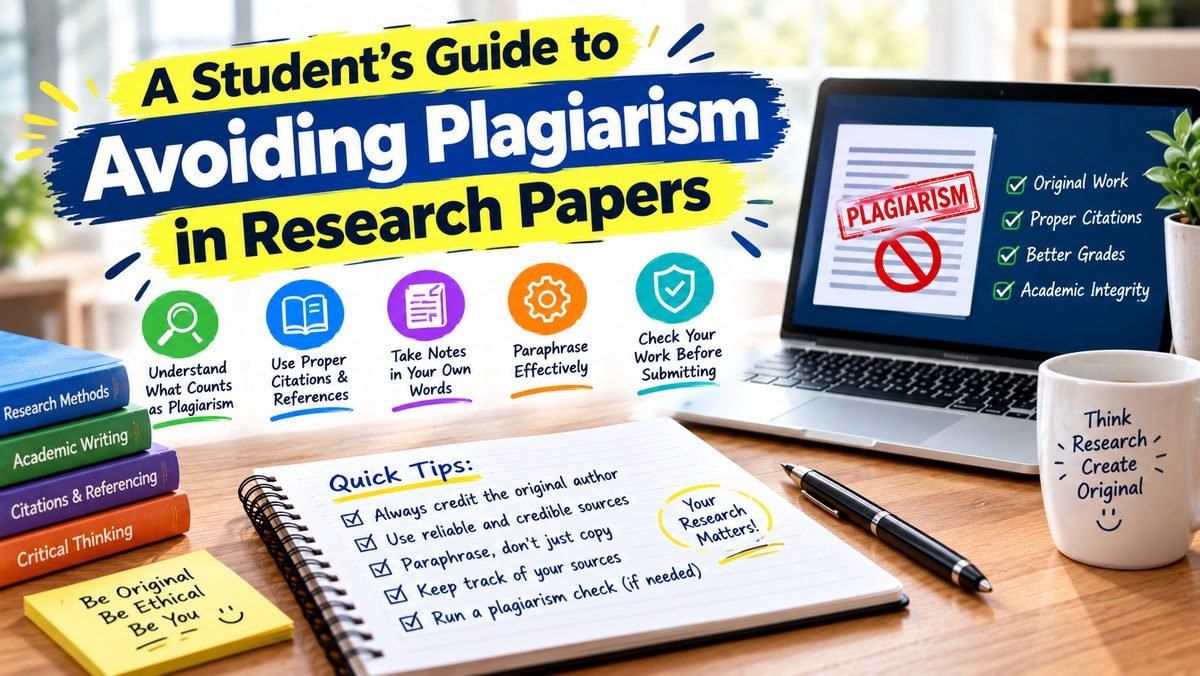
How to Prevent Accidental Plagiarism in Student Papers: Research Habits, Note-Taking Systems, and Drafting Workflows
In academic life, hearing the word "plagiarism" often evokes thoughts of deliberate dishonesty—students hiring essay mills, purchasing pre-written assignments, or blatantly copy-pasting entire articles from the internet. However, academic integrity boards and university professors know an unspoken truth: the vast majority of plagiarism in student research papers is completely unintentional.
Accidental plagiarism rarely happens during the final stages of typing a paper. Instead, it creeps in silently days or weeks earlier during the research phase. When students juggle dozens of browser tabs, academic journals, PDF downloads, and disjointed digital notes, ideas naturally begin to blend together. By the time a student sits down to draft their assignment under a tight deadline, the mental boundary between an author’s exact phrasing and their own original thought has completely dissolved.
Relying on last-minute proofreading or hoping a plagiarism scanner gives you a passing score is a dangerous strategy. Preventing intellectual property issues requires structured, proactive habits built directly into your research and drafting workflow. This comprehensive guide outlines the root causes of accidental plagiarism and provides an actionable, step-by-step framework to ensure your academic papers remain original, well-cited, and academically sound.
1. The Root Cause: How Ideas Bleed Together During Research
To fix a workflow problem, you must first understand where the breakdown occurs. In modern academic writing, the typical student workflow looks something like this:
- The student opens fifteen different journal articles across several browser windows.
- While skimming, they find an insightful paragraph, highlight it, and copy-paste it directly into a blank document to read later.
- Several days pass. The student returns to the document, begins assembling sentences, and forgets whether that specific line was a direct quote, a rough paraphrase, or their own original reaction.
- The copied sentence makes its way into the final submission without quotation marks or an in-text citation.
This cognitive blurring is exacerbated by cryptomnesia—a psychological bias where an individual misremembers an idea absorbed from an external source as their own spontaneous invention. If you do not create a strict physical and digital separation between borrowed facts and your personal commentary from day one, accidental plagiarism is almost guaranteed to happen.
2. Take Notes in Your Own Words From the Very Beginning
The most effective defense against accidental copying is to eliminate verbatim copy-pasting during your initial note-taking phase. Your notes should represent your active processing of the material, not an unstructured repository of other authors' sentences.
The "Read, Close, and Summarize" Technique
Whenever you encounter an important argument, study, or theoretical claim, follow this strict protocol:
- Read the passage or section completely until you understand the underlying point.
- Physically look away from the screen, turn over the page, or minimize the PDF.
- Type or write your summary of that point in a single, clear sentence using your own vocabulary before looking back at the source.
This process forces your brain to convert technical jargon into your own cognitive syntax. Because your notes are already written in your authentic voice, you drastically reduce the risk of structural mimicry when assembling your draft later.
The Visual Tagging Rule for Direct Quotes
There will be instances where an author phrases a concept with such precision or rhetorical power that you want to preserve the exact wording for a direct quote. If you must paste a sentence into your working notes, establish a non-negotiable visual protocol:
- Immediately place large quotation marks around the entire excerpt.
- Change the font color to bright red or highlight the block of text.
- Attach the author’s last name, publication year, and exact page number directly to the snippet (e.g., [Smith, 2023, p. 42]).
This simple visual habit ensures that you can never mistake a copied excerpt for your own writing, even if you return to your notes weeks later.
3. Build a Real-Time Running Bibliography as You Go
One of the most dangerous habits in student writing is postponing the bibliography until the draft is finished. Trying to reconstruct where an obscure statistic, historical date, or niche argument came from at 2:00 AM on the night before a deadline is where citation mistakes inevitably happen.
Capture Sources the Instant You Encounter Them
Every time you decide an article or book is relevant to your thesis, add it to a dedicated "Working References" page at the bottom of your document immediately. Document the essential metadata right away:
- Author name(s) and institutional affiliations.
- Publication date, title of the study, and journal or publisher name.
- Volume number, issue number, and exact page ranges.
- The Digital Object Identifier (DOI) or permanent stable URL.
Leverage Modern Reference Management Software
Manually tracking dozens of citations across different formatting manuals (such as APA, MLA, Chicago, or IEEE) invites human error. Integrate automated reference managers into your web browser and word processor:
- Zotero: A free, open-source desktop tool with a browser extension that saves citation metadata from academic databases with a single click.
- Mendeley: An excellent platform for organizing research PDFs, annotating studies, and automatically generating formatted bibliographies.
- EndNote: A robust, enterprise-level citation suite widely used in scientific and medical research environments.
4. The Split-Screen Trap: Draft From Notes, Never From Sources
With modern wide-screen monitors, students frequently practice "split-screen drafting": placing the published research paper on the left side of the screen and Microsoft Word or Google Docs on the right side. While convenient, this setup is a primary cause of patchwriting.
Why Split-Screen Drafting Fails
When you stare directly at an authoritative text while actively composing, you naturally borrow its grammatical pacing, transitional phrases, and rhetorical progression. Even if you consciously attempt to reword the text, your sentences end up structurally bound to the source.
The Ethical Alternative: Isolate Your Workspace
Close all primary sources when writing your rough draft. Open only your synthesized bullet-point notes. Because your notes contain only the core data points and conceptual summaries written in your own voice, your narrative progression will naturally reflect your personal writing style. You are building arguments from your own understanding, not reassembling someone else’s puzzle pieces.
5. Conduct a Systematic Pre-Submission Originality Audit
Before submitting any academic paper, you should subject your work to a dedicated originality and citation review that is completely separate from regular spell-checking or proofreading.
The Source-Density Check
Reread your paper with a critical eye, focusing specifically on sections with high citation density:
- Identify source-heavy paragraphs: Look for paragraphs that rely heavily on a single external author. Reread the sentences carefully. Does the passage read like a fresh analysis, or does it sound like a slightly rearranged summary of the source?
- Verify quotation accuracy: Ensure that every verbatim string of more than three or four words is safely enclosed within quotation marks and paired with a specific page number.
- Confirm citation matching: Check that every in-text citation (e.g., Johnson, 2022) has a corresponding, fully formatted entry in the reference list at the end of the document.
Handling Clunky or Borderline Sentences
If you identify a sentence that feels uncomfortably close to a reference text, do not simply open a thesaurus to swap words. Strip the sentence down completely. Ask yourself what concrete point you are trying to make, and rewrite the thought from a different perspective. If you are struggling with sentence structure, utilizing an automated paraphrasing tool can help suggest alternate grammatical arrangements—provided you manually review the output to verify factual precision and tone.
6. Dangerous Notes vs. Ethical Notes: A Side-by-Side Comparison
| Original Source Excerpt | Dangerous Note (Plagiarism Risk) | Ethical Note (Safe & Effective) |
|---|---|---|
| "Cognitive behavioral therapy demonstrates a 64% success rate in reducing generalized anxiety symptoms among adolescents within twelve weeks." (Miller, 2023, p. 115) | CBT shows a 64% success rate in lowering anxiety symptoms in teens over 12 weeks. (Miller) Problem: Kept original wording almost completely; lacks quotation marks; risks patchwriting. |
• Data: CBT dropped adolescent anxiety by 64% in a 3-month trial. • My thought: Useful evidence for Chapter 2 regarding rapid adolescent intervention. • Source: Miller (2023), p. 115. |
7. Frequently Asked Questions (FAQs)
Why do similarity scanners flag my paper if I had no intention of cheating?
Plagiarism detection algorithms (such as Turnitin or SafeAssign) do not have the ability to read your mind or judge your intentions. They perform mathematical text comparisons against billions of web pages and scholarly articles. If your sentence matches the vocabulary string and syntactic structure of an existing publication, it gets highlighted as an unoriginal match regardless of why it happened.
Is paraphrasing someone else’s research without a citation considered plagiarism?
Yes, absolutely. Rewriting an author's findings, data, or arguments in your own words changes the language, but it does not change the ownership of the idea. Presenting someone else's research without an accompanying citation constitutes paraphrasing plagiarism, which carries the exact same academic penalties as verbatim copying.
Can I reuse a paper I wrote for a previous university class?
In almost all academic institutions, submitting work completed for a previous course without the explicit permission of your current instructor is considered self-plagiarism. Academic coursework is designed to demonstrate new learning for each credit earned; recycling old submissions violates university honor codes.
Conclusion
Mastering academic writing is not simply about producing insightful conclusions; it is about building an ethical, repeatable process for managing knowledge. Accidental plagiarism is rarely an intellectual failing—it is a workflow breakdown. By summarizing sources from memory, maintaining real-time bibliographies, drafting away from open reference tabs, and conducting rigorous originality audits, you protect your academic standing, produce more authentic analysis, and cultivate research habits that will serve you throughout your professional career.