
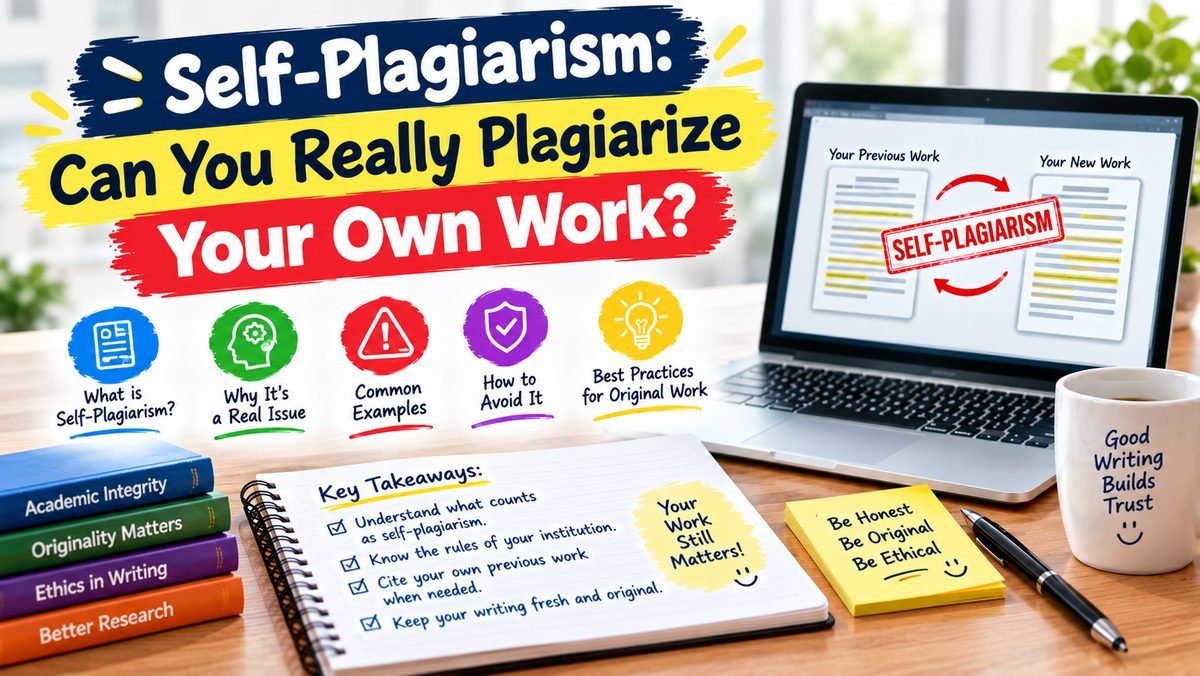
What Is Self-Plagiarism? The Ethics of Text Recycling, Institutional Rules, and How to Reuse Your Work Legally
To the average student, researcher, or freelance writer, the term "self-plagiarism" sounds like an inherent logical contradiction. How can an individual possibly steal something that already belongs to them? Plagiarism, in popular culture, is defined as the theft of another person’s intellectual property. Therefore, taking a paragraph you spent hours writing last year and pasting it into a new assignment or article feels completely harmless.
In modern academia, scholarly publishing, and professional content creation, however, self-plagiarism—frequently referred to as text recycling or duplicate publication—is recognized as a serious ethical violation. It catches writers completely off guard because it does not feel like theft while you are doing it. Yet university integrity boards issue disciplinary suspensions, academic journals retract published papers, and search engine algorithms demote websites based entirely on unauthorized self-duplication.
Understanding self-plagiarism is essential if you want to protect your academic transcripts, your professional reputation, and your digital publishing revenue. This comprehensive guide breaks down what strictly constitutes self-plagiarism, explains why institutions and digital platforms care so deeply about it, explores the legal copyright issues involved, and provides an actionable blueprint for repurposing your previous work ethically and legally.
1. What Counts as Self-Plagiarism: The 4 Primary Manifestations
Self-plagiarism is not a single uniform mistake; it appears across different professional and academic environments in several distinct formats:
A. Dual Submissions in Academic Coursework ("Double-Dipping")
The most widespread form of self-plagiarism among students is submitting the exact same paper, or extensive sections of it, to fulfill requirements in two different courses. For example, submitting an environmental policy essay written for a sociology course in the autumn semester to a political science class in the spring semester constitutes academic dishonesty unless both professors grant explicit, prior written permission.
B. Uncredited Text Recycling in Scholarly Publishing
In academic research, authors frequently publish multiple studies within the same specialized sub-discipline. Text recycling occurs when a researcher lifts verbatim paragraphs from their own literature reviews, methodology explanations, or theoretical frameworks and pastes them into a new journal submission without quotation marks or formal self-citation.
C. "Salami Slicing" (Data Fragmentation)
In scientific research, slicing a single comprehensive, multi-variable study into four or five tiny, minimally publishable units—and presenting each slice as an entirely separate, groundbreaking discovery—is known as salami slicing. This practice artificially inflates a researcher's publication count, clutters academic databases with redundant data, and distorts systematic literature reviews.
D. Redundant Digital Publishing and Content Syndication
For bloggers and digital publishers, copying substantial passages from an older, indexed article and republishing them under a new headline on the same domain or a secondary owned blog creates structural duplicate content. Search engine crawlers struggle to determine which URL holds canonical authority, resulting in organic traffic cannibalization and Google AdSense quality flags.
2. Why Institutions, Publishers, and Search Engines Care
The institutional concern surrounding self-plagiarism is not that you are robbing yourself of royalties or ideas. The core issue is that submitting recycled work as brand-new misrepresents the effort, novelty, and original value of the current deliverable.
Academic Integrity and the Credit Contract
When an academic institution charges tuition and awards degree credits, an implicit contractual agreement exists: you receive academic credit in exchange for completing new intellectual labor. Recycling a past essay misrepresents the work performed for the current course. It constitutes "double-counting" credit for a single output, giving the student an unfair advantage over peers who conducted original research from scratch.
Copyright Infringement and Legal Contracts
Many writers fail to realize that writing a piece does not automatically mean you retain the legal right to reuse it. In traditional book publishing, academic journals (like Elsevier, Springer, or Wiley), and corporate freelance work, authors routinely sign Copyright Assignment Agreements. Once signed, the legal copyright belongs to the publisher or client—not to you. If you copy verbatim passages from your previously published journal article into a new project, you are legally infringing on the publisher’s exclusive copyright.
Search Engine Rankings and Google AdSense Monetization
In digital marketing and web publishing, Google's Helpful Content System and Quality Rater Guidelines prioritize fresh, informative perspectives. If a webmaster repeatedly recycles their own articles across multiple URLs without unique additions, search engines view the practice as an attempt to artificially manipulate search rankings. Websites saturated with recycled, thin content face swift AdSense application rejections under the "Low Value Content" or "Scraped Material" categories.
3. Permissible Building Blocks vs. Prohibited Duplication
Does the prohibition of self-plagiarism mean you can never revisit a topic you have previously explored? Absolutely not. Intellectual growth requires expanding upon earlier foundations. The key distinction lies between building upon an idea and duplicating text wholesale.
| Scenario | Unethical Self-Plagiarism | Ethical Work Extension |
|---|---|---|
| University Term Papers | Copy-pasting three pages from last semester's paper into a new assignment without telling your instructor. | Informing your professor that you are expanding earlier findings, citing your prior draft, and rewriting the background text from scratch. |
| Scientific Publications | Submitting identical clinical data to two competing journals to increase total citation metrics. | Conducting a follow-up trial, including 50% new longitudinal data, and explicitly citing the baseline study in the bibliography. |
| Blog & Web Publishing | Pasting an old 1,000-word blog post into a new URL with a slightly altered title to capture another keyword. | Synthesizing key insights into a comprehensive hub guide, updating outdated statistics, and implementing proper rel="canonical" tags. |
4. A 3-Pillar Framework to Reuse Your Work Legally and Ethically
If you genuinely want to expand, adapt, or build upon research you conducted in the past, follow this simple, repeatable three-pillar protocol:
Pillar 1: Full Upfront Disclosure (The Permission Rule)
Transparency is your ultimate ethical shield. Before you type a single sentence of a new assignment, consult your instructor, journal editor, or corporate client:
- Explain clearly: "In a previous semester, I researched the foundational economic aspects of this issue. I would like to expand that research by analyzing the regulatory consequences for this assignment."
- Provide a copy of the original piece so the evaluator can assess the baseline.
- Secure written permission (via email) before proceeding. Most evaluators welcome thoughtful research extensions, provided you ask first.
Pillar 2: Formal Self-Citation
Treat your past self exactly as you would treat an external scholar. If you reference a theory, survey dataset, or argument you published earlier, cite it formally using standard citation styles:
- APA Style: (Smith, 2023) within the text, paired with a complete bibliographic reference.
- Digital Web Publishing: Insert a direct contextual hyperlink back to your original source article, clearly stating: "As discussed in our earlier exploration of enterprise architecture..."
Pillar 3: Syntactic Reconstruction (Rewrite, Never Copy)
Even when building on your past ideas, resist the urge to copy and paste background summaries or literature reviews. Read your prior work, close the file, and rewrite the foundational concepts from memory. This ensures the sentence structure, tone, and pacing integrate seamlessly into your new document while maintaining algorithmic uniqueness.
5. Frequently Asked Questions (FAQs)
Can automated scanners like Turnitin detect self-plagiarism?
Yes, with incredible precision. Institutional plagiarism engines archive every paper submitted to university databases worldwide. If you submit a paper that matches an essay you submitted two semesters ago—even at a completely different institution—the scanner will highlight the overlapping text and display a high similarity index to your professor.
Can I cite an unpublished paper I wrote for a class?
Yes. Both APA and MLA manuals provide specific formatting rules for citing unpublished manuscripts, course assignments, or personal class notes. Formally citing an unpublished paper signals to your evaluator that you are referencing earlier academic work transparently.
Does republishing my own Medium article on my personal blog hurt my SEO?
It can dilute your organic search performance if handled improperly. When cross-posting identical content across platforms, always specify a cross-domain canonical tag pointing to your primary authoritative URL, or ensure the secondary publication features substantial revisions, updated sections, and fresh analysis.
Is reusing your own software code considered self-plagiarism?
In commercial software development, reusing utility libraries, standardized algorithms, and boilerplate functions is encouraged as standard practice. However, in computer science coursework, recycling assignments across different programming classes without instructor clearance violates institutional academic honesty policies.
Conclusion
Self-plagiarism is not an issue of intellectual theft; it is an issue of transparency, fairness, and contractual integrity. When you pass off recycled work as an original creation, you undermine the trust placed in you by readers, professors, and editors. By prioritizing full upfront disclosure, citing your past contributions formally, and rewriting overlapping concepts from scratch, you can boldly build upon your intellectual history without compromising your ethical standing or risking institutional penalties.