
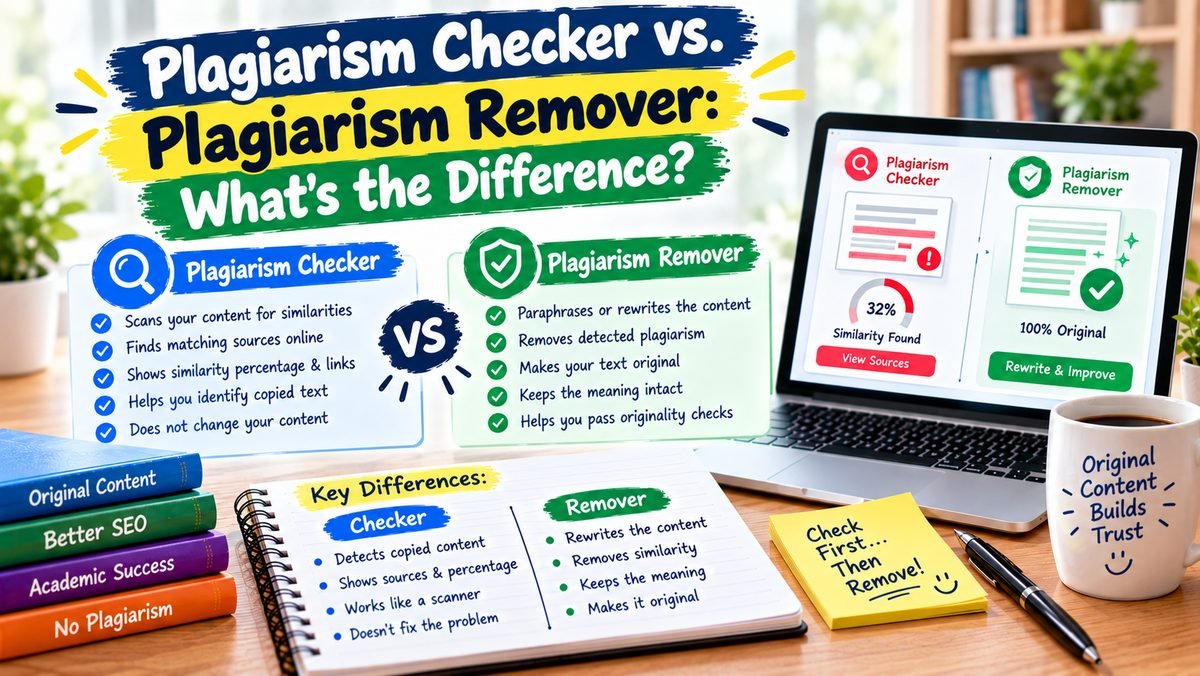
Plagiarism Checker vs. Plagiarism Remover: Key Differences and Which Tool You Actually Need
In modern digital writing, academic research, and online content production, terminology often gets blurred. Two phrases that are routinely used interchangeably by students, freelance copywriters, and web publishers are "plagiarism checker" and "plagiarism remover." Search for either term online, and you will encounter marketing pages promising instant originality, algorithmic safety, and pristine writing scores.
However, treating these two instruments as identical solutions is a fundamental mistake. While both belong to the broader writing assistance ecosystem, they address two completely different stages of the composition workflow. Confusing a checker with a remover is akin to confusing an X-ray machine with a surgeon: one diagnoses the underlying issue, while the other actively performs the necessary procedure to resolve it.
Whether you are finalizing a university thesis, refining an article for client delivery, or optimizing blog posts for Google AdSense approval, knowing precisely when to deploy a diagnostic scanner and when to leverage an active rewriting tool will save you dozens of hours of editorial frustration. This comprehensive guide breaks down how both technologies operate, contrasts their functional differences, explains why specialized tools like QuillShield prioritize remediation, and outlines an optimal workflow for seamless, 100% original writing.
1. A Plagiarism Checker: The Diagnostic Tool That Identifies the Problem
At its core, a plagiarism checker is an analytical audit tool. It is designed to inspect a piece of writing, compare its text against extensive databases, and report back where identical or uncomfortably similar passages already exist on the internet or within academic archives.
How Detection Engines Operate
When you feed an essay or article into a plagiarism checker (such as Turnitin, Copyscape, or Grammarly), the software breaks down your document into small string fragments called n-grams. It then cross-references these linguistic strings across three massive data silos:
- Billions of public, indexed web pages across search engines.
- Proprietary databases of academic journals, books, and scientific white papers.
- Institutional repositories containing millions of previously submitted student papers.
The Output: Quantitative Similarity Metrics
The end deliverable of a plagiarism checker is purely informational. It generates a comprehensive similarity report highlighting matching lines of text in bright colors, providing URLs to the original sources, and calculating a total similarity percentage (e.g., "18% matched content").
The Critical Limitation: A plagiarism checker is entirely passive. It informs you that a paragraph matches an existing source, but it does absolutely nothing to fix it. It does not suggest structural revisions, it does not rephrase clumsy syntax, and it cannot alter a single word in your document. It leaves the entire burden of remediation squarely on your shoulders.
2. A Plagiarism Remover: The Curative Tool That Actively Fixes the Problem
If a plagiarism checker is the diagnostic scan that reveals where an issue lies, a plagiarism remover (commonly known as a specialized paraphrasing or sentence restructuring tool) is the therapeutic treatment that resolves it.
How Rewriting Engines Operate
A plagiarism remover utilizes advanced Natural Language Processing (NLP) models to ingest a flagged sentence or paragraph and completely reconstruct its architectural blueprint. Unlike primitive word spinners that simply swap individual words with bizarre synonyms, a high-caliber remover understands the semantic context and core ideas of the passage.
The remover achieves uniqueness by applying structural linguistic transformations:
- Inverting independent and dependent clauses.
- Transitioning between active and passive constructions appropriately.
- Breaking apart complex run-on sentences into clean, impactful statements.
- Selecting natural, context-aware vocabulary that matches the intended editorial register.
The Output: Ready-to-Use, Original Text
Instead of merely returning a scary red highlight and an arbitrary percentage, a plagiarism remover provides an immediately usable, fluent paragraph that retains all your original empirical facts, numerical figures, and core arguments while delivering a completely fresh syntactic structure. You can drop this reconstructed text directly back into your working document with confidence.
3. Plagiarism Checker vs. Plagiarism Remover: A Direct Comparison
| Evaluation Criteria | Plagiarism Checker | Plagiarism Remover / Rewriter |
|---|---|---|
| Primary Function | Diagnostic: Identifies where text matches external sources. | Remedial: Actively restructures sentences to eliminate duplication. |
| Document Modifications | Makes zero changes; your text remains identical. | Generates a completely new, rewritten version of your text. |
| Deliverable Format | A similarity percentage score with highlighted URLs. | A polished, original paragraph ready for immediate publication. |
| Ideal Phase in Workflow | The very final step: pre-submission auditing of a complete draft. | The drafting & revision phase: resolving specific difficult passages. |
| Factual Integrity Risk | Zero risk (it changes nothing). | Requires quick human proofreading to ensure data remains intact. |
4. When to Use Each Tool in Your Editorial Pipeline
To produce exceptional writing without wasting valuable time, you should integrate both tools into a logical, sequential workflow rather than treating them as competitors.
When to Use a Plagiarism Checker:
- Pre-Submission Audits: When your term paper, dissertation, or client deliverable is 100% finished, and you need a high-level safety check against web archives.
- Broad Literature Reviews: When evaluating a multi-page document to ensure you didn't inadvertently miss an in-text citation or leave quotation marks off an excerpt.
- Client Editorial Gatekeeping: When editorial agencies or blog managers need to verify that a freelance writer delivered original copy before approving an invoice.
When to Use a Plagiarism Remover:
- Overcoming Source Mimicry: When you have just finished researching a technical concept and realize your draft mirrors the reference article too closely.
- Refining Clunky Rough Notes: When converting raw, fragmented research points into cohesive, flowing body paragraphs.
- Targeted Remediation: When a plagiarism checker highlights a specific, troublesome paragraph that you need to untangle and rewrite in seconds.
5. Why Specialized Platforms (Like QuillShield) Focus on the Remover
Many multi-purpose software suites attempt to combine full-web plagiarism scanning with automated rewriting into a single monolithic package. However, this often results in compromised performance on both fronts.
The Technical Fragility of Live Web Checkers
Live web-scanning engines depend on massive, continuous network access to distributed search infrastructure and third-party web indexing APIs. On many server environments and web hosting setups, these connections face strict rate limits, latency bottlenecks, and network interruptions. A web checker that fails to index a newly published competitor page provides a dangerous false sense of security.
The Power of Focused Execution
Dedicated tools like QuillShield intentionally focus on mastering the single most critical half of the equation: high-precision textual remediation. Rather than burning computational overhead on fragile web-scanning queries, the architecture concentrates entirely on semantic intelligence. It takes a passage you already know is problematic and reconstructs it into fluent, natural, and completely original phrasing that you can rely on instantly.
By prioritizing sentence architecture, syntactic depth, and factual preservation, a dedicated remover ensures that the resulting text sounds like an authoritative human writer rather than an awkward robotic translation.
6. Ethical Guidelines When Using a Plagiarism Remover
While a plagiarism remover is an indispensable writing assistant, it must be deployed with intellectual honesty and editorial care:
- The Human-in-the-Loop Principle: Never blindly copy and paste rewritten text without reading it through. You must verify that the tone aligns with your personal style and that the narrative flows smoothly into your surrounding paragraphs.
- Verify Factual and Numerical Fidelity: Check that every statistic, date, proper noun, and technical parameter was preserved accurately during the restructuring process.
- Attribution Remains Mandatory: Rewriting an author's unique theory, framework, or proprietary dataset in brand-new words removes verbatim copying, but it does not remove the need for attribution. Always credit the primary source via a citation or contextual hyperlink.
7. Frequently Asked Questions (FAQs)
Can a plagiarism checker fix my sentences for me?
No. A plagiarism checker is solely an analytical scanner. It will show you which phrases match existing websites or journals, but it cannot alter or rephrase your writing. To fix flagged sentences, you must either rewrite them manually or process them through a plagiarism remover.
Is using a plagiarism remover considered cheating in academic institutions?
It depends on institutional policy and how the tool is used. Using a remover to help clarify your thoughts, improve awkward sentence structure, or synthesize rough notes is generally viewed as an assistive drafting aid, similar to an advanced grammar checker. However, using a tool to rewrite another student's entire essay wholesale without performing original research constitutes academic misconduct.
Does rewritten content pass Google’s search quality evaluations?
Yes, provided the text is helpful, clear, and provides genuine value to the reader. Google's Search Quality Evaluator Guidelines prioritize content that demonstrates expertise and answers search queries effectively. High-quality paraphrasing tools that generate natural, human-grade prose avoid the repetitive patterns associated with low-effort spam.
Conclusion
Navigating the demands of modern writing requires selecting the appropriate tool for the specific task at hand. A plagiarism checker is your rear-view mirror—it looks back at existing databases to warn you of potential overlaps. A plagiarism remover is your steering wheel—it actively maneuvers your prose into clear, authentic, and original phrasing. By understanding the distinct roles of detection and remediation, you can streamline your writing pipeline, eliminate duplicate content risks, and craft authoritative articles that command respect from human readers and search engines alike.