
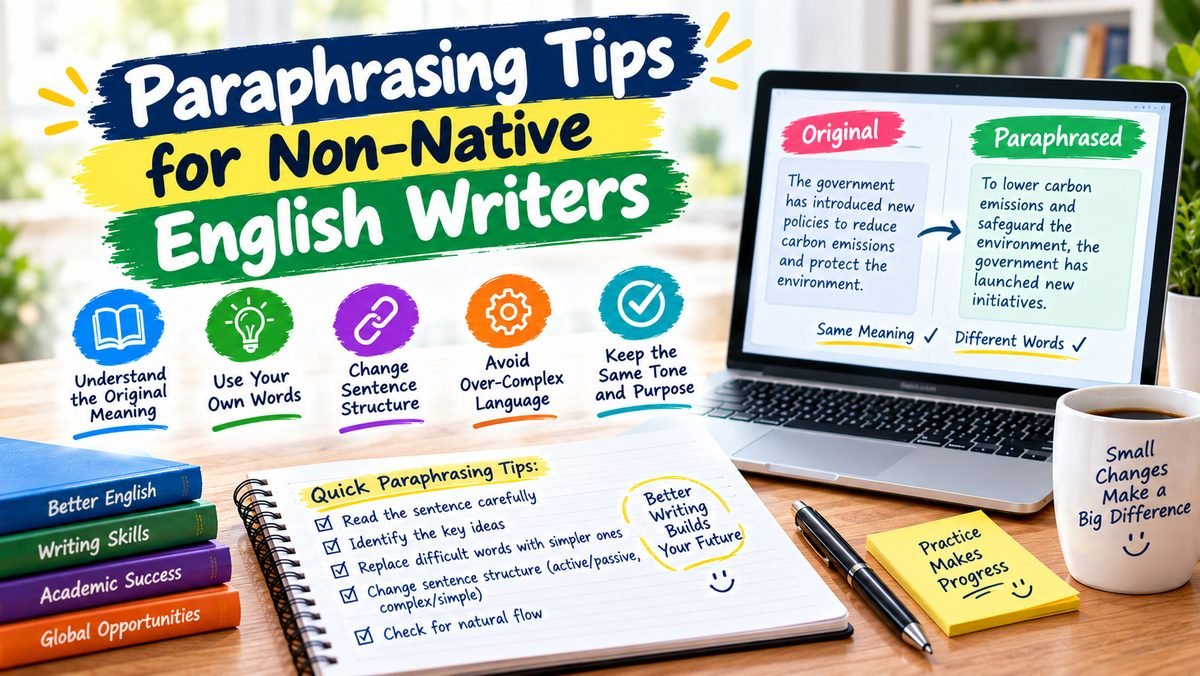
Paraphrasing for Non-Native English Writers: Proven Strategies to Rewrite Confidently Without Plagiarism or Translation Traps
In modern academia, scientific research, and global digital publishing, English functions as the undisputed international lingua franca. Scholars, freelance copywriters, and online publishers from around the world are expected to articulate complex theories, argue nuanced positions, and communicate empirical datasets in English. For multilingual writers—those writing in English as a Second or Foreign Language (ESL/EFL)—this creates a profound, multifaceted hurdle.
Paraphrasing is already an intricate intellectual skill that requires considerable practice for native speakers. Doing it in a language you are still actively mastering adds an entirely new dimension of cognitive friction. Non-native English writers often find themselves trapped between two equally hazardous extremes: staying so uncomfortably close to the reference text that automated scanners flag their work as patchwriting or plagiarism, or translating thoughts so literally from their mother tongue that the resulting English sentences become confusing, ungrammatical, or factually inaccurate.
Fortunately, mastering authentic paraphrasing in English does not require you to possess the vocabulary of a 19th-century novelist. It simply requires deliberate adjustments to how you read, draft, and refine your prose. This comprehensive guide outlines the psychological and linguistic challenges ESL authors face, breaks down critical reading techniques, exposes the hidden traps of literal translation, and demonstrates how to leverage rewriting tools as active educational tutors to produce fluent, 100% original content.
1. Read the Source More Than Once: Decoding Nuance and Critical Modifiers
The foundation of accurate paraphrasing is flawless comprehension. When native speakers read an English passage, they instantly recognize subtle idioms, cultural metaphors, and semantic hedges. For ESL authors, however, processing complex sentence clauses often consumes so much mental bandwidth that vital qualifying words are completely overlooked.
The Immense Power of Qualifying Words
In academic and professional writing, claims are rarely absolute. Researchers deliberately temper their assertions using specific qualifiers and modal verbs. If a non-native writer misses or misinterprets even one of these small words, the entire meaning of the rewritten sentence flips upside down:
- Frequency Modifiers: "Usually," "rarely," "predominantly," "seldom," "sporadically." (Notice how changing "Patients rarely experience migraines" to "Patients experience migraines" converts an exceptional anomaly into a standard clinical outcome).
- Certainty & Probability Modifiers: "Possibly," "plausibly," "indicates," "demonstrates," "proves." (Claiming that a preliminary hypothesis "proves" a phenomenon misrepresents scientific methodology).
- Quantity & Scope Modifiers: "Some," "a fraction of," "the majority," "isolated instances."
The Three-Pass Reading Exercise
Before typing a single word of your paraphrase, read the reference passage three distinct times with different objectives:
- Pass 1 (Gist): Read the entire paragraph to grasp the general topic without stopping at unfamiliar vocabulary.
- Pass 2 (Linguistic Analysis): Re-read with a dictionary. Highlight words you do not recognize, identify all qualifying words, and circle the primary subject and verb.
- Pass 3 (Conceptual Synthesis): Read it one final time and ask yourself: "What is the single most important takeaway that the author wants me to know?"
2. The "Simpler English First" Method: Draft for Clarity Before Elegance
One of the most destructive habits non-native writers exhibit is opening an academic thesaurus immediately. In an attempt to sound sophisticated, authoritative, or "native," writers grab five-syllable synonyms and attempt to build elaborate, multi-clause sentences. The result is almost always a tangled grammatical knot that confuses readers and fails algorithmic readability audits.
Drafting in Plain English (Phase One)
Do not attempt to match the linguistic density or decorative vocabulary of the original text on your initial attempt. Your primary goal is conceptual accuracy, not stylistic flair.
- Write out the core idea using the simplest, most elementary English vocabulary you are 100% comfortable with.
- Stick strictly to the foundational Subject + Verb + Object (SVO) sentence structure.
- Do not worry about sounding basic; focus entirely on capturing the correct empirical facts, relationships, and causal links.
It is infinitely easier to polish a simple, accurate sentence into an authoritative academic statement than it is to untangle an ambitious, grammatically broken paragraph that has obscured its underlying meaning.
Stylistic Elevation (Phase Two)
Once your simple baseline sentence accurately represents the source data, execute a second editorial pass to elevate its professional register:
- Incorporate formal transitional adverbs (e.g., "Consequently," "Furthermore," "In contrast").
- Consolidate basic clauses into cohesive sentences using relative pronouns ("which," "that," "wherein").
- Replace generic verbs (like "make" or "get") with precise analytical verbs (like "generate," "acquire," "facilitate," or "corroborate").
3. Watch for False Friends and Literal Translation Traps
Multilingual writers routinely compose sentences in their native language and mentally translate them into English word-for-word. While this feels natural, it exposes your writing to severe structural distortions.
The Hazard of "False Friends" (False Cognates)
False friends are words across different languages that look or sound remarkably similar but carry fundamentally different definitions. For example:
- In Spanish/Portuguese, actual means "current" or "present-day," whereas in English, actual means "real" or "factual."
- In French, sensible means "sensitive," whereas in English, sensible means "practical" or "reasonable."
- In German, eventuell means "possibly," whereas in English, eventually means "in the end" or "finally."
Relying on phonetic or visual similarities between your mother tongue and English leads to bizarre semantic shifts that undermine your credibility.
Syntactic Dislocation: Inverting Word Orders
Different languages structure narrative logic differently. For instance, languages like Urdu, Hindi, Arabic, Japanese, or German frequently place verbs at the very end of sentences, use elaborate post-positional phrasing, or drop explicit grammatical subjects altogether. Translating these patterns literally into English creates awkward, backwards sentences. When a rewritten sentence feels stiff or unnatural, do not adjust individual words—demolish the entire sentence structure and rebuild it using direct English sequencing.
4. Transform Rewriting Tools into Active Learning Accelerators
With the widespread availability of advanced AI paraphrasers and specialized rewriting engines (such as QuillShield or QuillBot), ESL authors often wonder if utilizing these tools is acceptable. The answer depends entirely on whether you treat the technology as a crutch or an educational tutor.
The Danger of Passive Copy-Pasting
If you paste a source paragraph into an automated tool and blindly paste the output into your paper without reading it, you learn nothing. Worse, software tools can misinterpret technical contexts or insert inappropriate synonyms that ruin your paper’s academic validity.
The Comparative Study Method (Learning While Writing)
To turn rewriting tools into a powerful professional development mechanism, adopt this active three-step routine:
- Produce your own attempt first: Write the best paraphrase you can manage using your simple English baseline.
- Generate an automated restructuring: Run the passage through your chosen paraphrasing tool to observe how an advanced language model reconstructs the clause hierarchy.
- Conduct a side-by-side linguistic audit: Compare your attempt with the tool’s output. Notice specifically:
- Where did the tool place the primary dependent clause?
- Which prepositions did it select (e.g., "invest in" vs. "invest into")?
- How did it link two choppy thoughts into a fluid, elegant compound sentence?
By actively analyzing these differences, you assimilate authentic English syntax into your personal writing toolkit, improving your natural fluency with every single paragraph you rewrite.
5. Side-by-Side Deconstructions: ESL Paraphrasing in Practice
| Version | Sample Passage | Linguistic Breakdown & Flaws |
|---|---|---|
| Original Academic Source | "Although microfinance initiatives predominantly empower rural female entrepreneurs, some programs inadvertently exacerbate household financial debt due to extortionate interest rates." | Dense academic tone containing critical qualifiers ("predominantly," "some," "inadvertently"). |
| Flawed Attempt (Direct Translation / Patchwriting) | "Although small loan projects mostly give power to village women business owners, few programs without intention increase family money debt for high interest rates." | Awkward phrasing ("give power," "family money debt"); incorrect preposition ("for" instead of "because of"); retains exact original clause order. |
| Phase 1: Simple English Baseline | "Microfinance helps village women start businesses. However, a few of these programs charge very high interest. This causes some families to fall into deeper debt without meaning to." | 100% accurate; separates complex thoughts into clear, simple sentences; all qualifiers preserved intact. |
| Phase 2: Polished Professional Paraphrase | "While microfinance programs primarily assist rural women in launching commercial enterprises, exorbitant interest fees can occasionally push vulnerable households into severe debt." | Completely restructured syntax; elegant academic vocabulary; flawless preservation of all empirical caveats and data points. |
6. A 4-Point Self-Audit Checklist for Non-Native Writers
Before submitting any paraphrased document to an instructor, client, or publisher, run through this specialized non-native editing checklist:
- 1. The Preposition Check: English prepositions (in, on, at, by, for, with, to) rarely translate directly from other languages. Double-check common verb-preposition pairings (e.g., you participate in, not participate to; you focus on, not focus at).
- 2. Article Accuracy (A, An, The): Many languages (like Russian, Urdu, or Mandarin) do not utilize definite or indefinite articles. Verify that singular countable nouns have appropriate articles attached.
- 3. Subject-Verb Agreement: Ensure that complex compound subjects match their corresponding verbs in singular and plural configurations (e.g., "The group of international researchers is conducting," not "are conducting").
- 4. Algorithmic Plagiarism Verification: Process your final draft through a reliable similarity checker like Turnitin or Copyscape to confirm that your sentence structures do not mirror the source too closely.
7. Frequently Asked Questions (FAQs)
Can I use translation software like Google Translate or DeepL to paraphrase?
Translators can assist in looking up unknown vocabulary, but using them to translate entire paragraphs wholesale is risky. Automated translation often generates awkward literal phrasing and sentence rhythms that modern similarity algorithms easily identify as unoriginal or low-quality spun copy.
Why do plagiarism scanners flag non-native English writers so frequently?
Non-native writers often lack the broad vocabulary required to reconstruct sentences easily, leading them to rely heavily on the exact words and sentence structures of the source text. This unintentional patchwriting mathematically triggers similarity detection software, even when the writer had zero intent to cheat.
Do I still need to cite a source if I spent hours rewriting it into simple English?
Yes, absolutely. Citing a source is about acknowledging who created the underlying research, data, or theory. Changing the language into simple, accessible English does not change the intellectual ownership of the idea. Always include an academic citation or a web hyperlink.
Conclusion
Writing and paraphrasing in English as a second language is undeniably challenging, but it is also an extraordinary cognitive advantage. Multilingual writers possess the unique ability to conceptualize ideas across different linguistic frameworks. By moving away from premature thesaurus hunting, prioritizing simple and accurate drafts, avoiding false friends, and leveraging digital rewriting tools as active mentors rather than passive shortcuts, you can express complex global research with absolute confidence, uncompromising academic integrity, and effortless originality.