
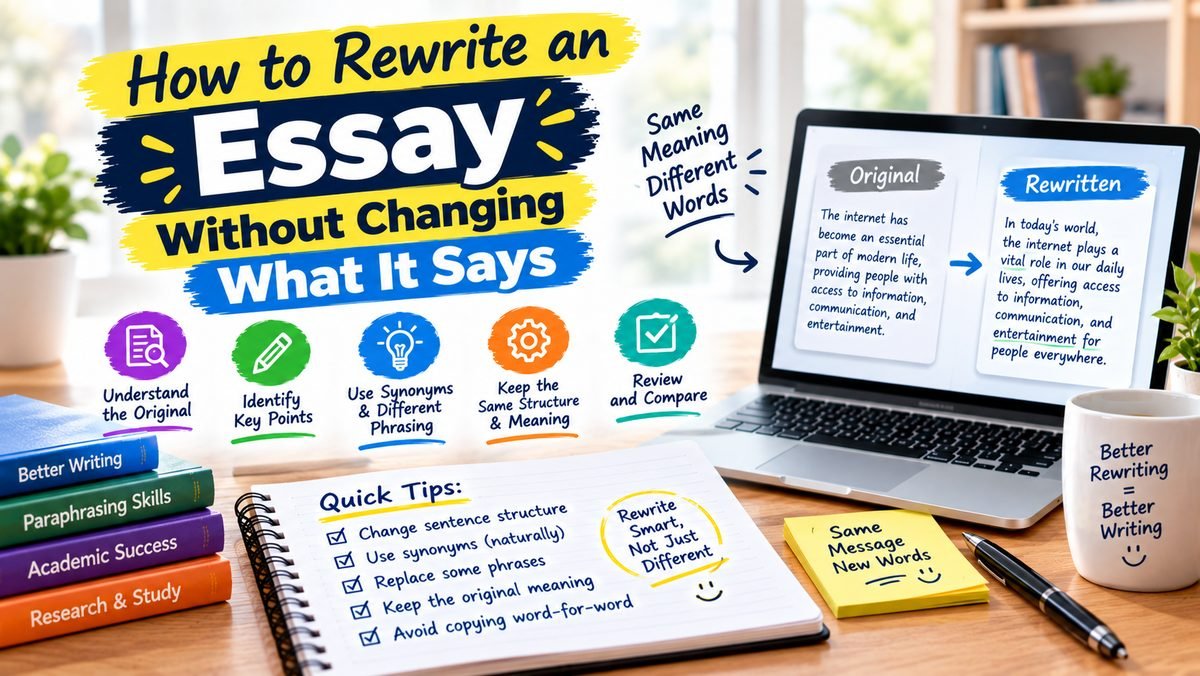
How to Rewrite a Paragraph Accurately: Preserving Facts, Maintaining Logical Rigor, and Ensuring 100% Originality
On the surface, rewriting a paragraph seems like one of the simplest editorial tasks in writing. Anyone with access to a basic dictionary or an automated tool can swap a few nouns, rearrange a couple of phrases, and present a sentence in a fresh outfit. However, professional copywriters, academic researchers, and digital publishers know that cosmetic rewriting is fraught with hidden hazards.
The true difficulty does not lie in changing the words; the challenge lies in rewriting a passage without accidentally altering an empirical fact, softening a rigorous argument, or stripping away a crucial caveat. When writers attempt to paraphrase complex ideas quickly, they frequently fall into one of two dangerous extremes: either they commit patchwriting (staying so uncomfortably close to the source that it triggers plagiarism warnings), or they drift into semantic distortion (altering the phrasing so aggressively that the underlying claim becomes inaccurate or misleading).
Whether you are drafting a research paper, synthesizing industry reports, or building high-authority content for Google AdSense monetization, mastering precision rewriting is essential. This comprehensive guide details how to separate facts from phrasing, execute syntactic transformations from scratch, preserve argumentative cohesion, and conduct rigorous side-by-side audits to ensure absolute fidelity and complete originality.
1. Separate the Facts from the Phrasing: The Information Architecture Framework
Every piece of expository writing contains two distinct layers: immutable data and mutable styling. Confusing these two elements is the leading cause of distorted rewrites.
Immutable Data (What Must Never Change)
Before you begin typing your rewrite, you must mentally or physically isolate the core informational anchors of the passage. These elements are objective and must survive the rewriting process with 100% precision:
- Quantitative Metrics and Data: Percentages, monetary valuations, sample sizes, ratios, dates, and statistical confidence intervals.
- Proprietary Entities and Proper Nouns: Specific company names, geographic locations, research initiatives, clinical trial designations, and individual names.
- Empirical Cause-and-Effect Claims: The specific relationship identified by the author (e.g., whether Variable A caused Variable B, or merely correlated with it).
- Technical and Scientific Nomenclature: Standardized terms like "photosynthesis," "machine learning pipeline," or "systemic inflation" that lack accurate everyday synonyms.
Mutable Styling (What You Are Free to Transform)
Everything else surrounding the data is fair game for creative restructuring. This includes rhetorical pacing, sentence order, active versus passive voice, vocabulary choice, metaphors, explanatory analogies, and transitional signposts.
The Warning Against Semantic Creep: Pay close attention to modal qualifiers. Changing "evidence suggests a possible link" into "the study proves" is not clever paraphrasing; it is an empirical falsehood that misrepresents scientific consensus.
2. Rewrite in Full Sentences, Not Word-by-Word
The fastest way to produce robotic, unreadable, and flagged content is to read a sentence with your left hand on the keyboard and your right hand hovering over an online synonym finder. This piecemeal, word-by-word substitution is the hallmark of patchwriting.
The Macro-Sentence Synthesis Method
Professional rewriting requires you to step back from microscopic word choices and grasp the macroscopic mental model of the author. Practice the following workflow:
- Read the complete thought: Ingest the entire sentence or compound clause to understand its total objective.
- Identify the thematic anchor: Determine what the primary subject is doing and why it matters.
- Break line of sight: Look away from the source document entirely to prevent visual anchoring.
- Construct a new architecture from scratch: Build a completely fresh sentence around a different starting point.
Tactics for Structural Reconstruction
Instead of searching for synonyms, alter the grammatical framework using proven syntactic levers:
- Invert the Clause Order: If the original author presents a premise followed by a consequence, lead with the consequence and detail the operational mechanics afterward.
- Split Compound Constructs: Transform winding, comma-laden academic sentences into two punchy, direct assertions.
- Shift the Grammatical Subject: If the original sentence is focused on a tool (e.g., "The software automates reporting"), shift the focus to the user (e.g., "Enterprise analysts save hours by leveraging automated reporting tools").
3. Maintain Argumentative Rigor and Logical Cohesion
A paragraph is not merely an arbitrary cluster of sentences; it is an organized logical argument. Good paragraphs open with a premise, introduce supporting evidence, address counter-perspectives, and culminate in an analytical conclusion.
Protecting the Connective Tissue
During aggressive rewriting, writers frequently discard tiny but vital transitional words. Eliminating words like "however," "consequently," "nevertheless," "despite this," or "furthermore" destroys the logical bridge connecting your points.
Consider the disastrous difference:
- Original: "The company expanded revenue by 20%. However, supply chain bottlenecks led to an overall operational deficit." (Clear contrast showing financial trouble).
- Careless Rewrite: "The business grew sales by 20%. Logistics problems occurred in shipping." (The causal link explaining why higher sales still resulted in losses is completely severed).
Avoid Softening the Author's Stance
Writers often soften strong assertions with weak language out of fear of misquoting. If an original study boldly states that "smoking directly accelerates cardiovascular degradation," rewriting it as "smoking might have some negative influence on heart health" robs the argument of its factual gravity and analytical force.
4. Practical Side-by-Side Deconstructions
To see how accurate, high-authority rewriting functions in practice, review the following real-world scenarios:
Case Study: Business Strategy and Operations
Original Excerpt:
"Adopting agile project management methodologies reduced software delivery timelines by 34% across enterprise development teams, though initial implementation costs escalated by roughly $150,000 during the first fiscal quarter."
Poor Rewrite (Patchwriting & Fact Softening - High Risk):
"Embracing agile project administration strategies lowered program shipping times by 34% across large development crews, although early launch expenses went up by around $150,000 in the first quarter."
(Verdict: Blatant synonym swapping; sentence cadence is identical; intellectual structure remains borrowed.)
Precision Professional Rewrite (Ethical, Accurate, & Unique):
"Enterprise engineering departments cut their software release cycles by more than a third after transitioning to agile frameworks. However, this deployment efficiency required a substantial upfront investment, generating approximately $150,000 in additional administrative overhead throughout the initial three months."
(Verdict: Flawless preservation of numerical data [34% = more than a third, $150,000, first quarter]; completely reimagined syntax; robust logical contrast preserved via 'However'.)
5. The 4-Point "Before and After" Audit Checklist
Once you finish rewriting a passage, never hit publish or submit immediately. Place the original text and your newly crafted version side by side, and execute this strict four-step verification audit:
| Audit Checkpoint | Key Question to Ask Yourself | What to Look For |
|---|---|---|
| 1. Factual Reconciliation | Did any numbers, claims, or technical facts change? | Cross-check every percentage, proper name, financial metric, and chronological timeline directly against the original text. |
| 2. Argumentative Integrity | Does the rewritten paragraph reach the exact same logical conclusion? | Ensure transitions like therefore, because, and in contrast are working correctly and the stance remains firm. |
| 3. Syntactic Divergence | Did you build a new sentence structure, or just swap words? | Check sentence lengths and opening clauses. If your sentences begin with the exact same grammatical subjects as the source, restructure them. |
| 4. Tone and Contextual Fit | Does the rewritten text sound like your authentic voice? | Read the paragraph out loud within the context of your broader article to confirm it integrates smoothly into your narrative flow. |
6. Frequently Asked Questions (FAQs)
Can changing sentence order alter the meaning of a paragraph?
Yes. If a paragraph explains a chronological historical process or a step-by-step scientific experiment, shifting sentences out of sequential order can create confusion regarding which event triggered another. Always verify that chronological and logical progressions remain intact.
How do I rewrite technical or industry terminology that has no synonyms?
You do not need to replace established terminology. Specialized concepts (such as "gross domestic product," "Search Engine Optimization," or "deoxyribonucleic acid") should remain unchanged. True paraphrasing focuses on transforming the surrounding syntax, transitions, and contextual explanations rather than mutilating precise scientific terms.
Does accurate rewriting help with Google AdSense approval?
Absolutely. Google's Search Quality Evaluator Guidelines specifically devalue websites featuring superficial synonym-spun content ("Low Value Content"). When you synthesize information cleanly, maintain factual accuracy, and integrate your own perspective, search engines and AdSense evaluators recognize your site as an authoritative, high-value resource.
Conclusion
Accurate paragraph rewriting is not an exercise in mechanical word substitution; it is a discipline grounded in rigorous comprehension, analytical fidelity, and syntactic craftsmanship. By deliberately isolating immutable facts from stylistic phrasing, drafting new sentences away from visual source anchors, and verifying logical integrity through side-by-side audits, you produce work that is intellectually honest, factually reliable, and uniquely your own. In a modern content ecosystem crowded with careless rewrites and algorithmic fluff, precision rewriting is your strongest competitive advantage.