
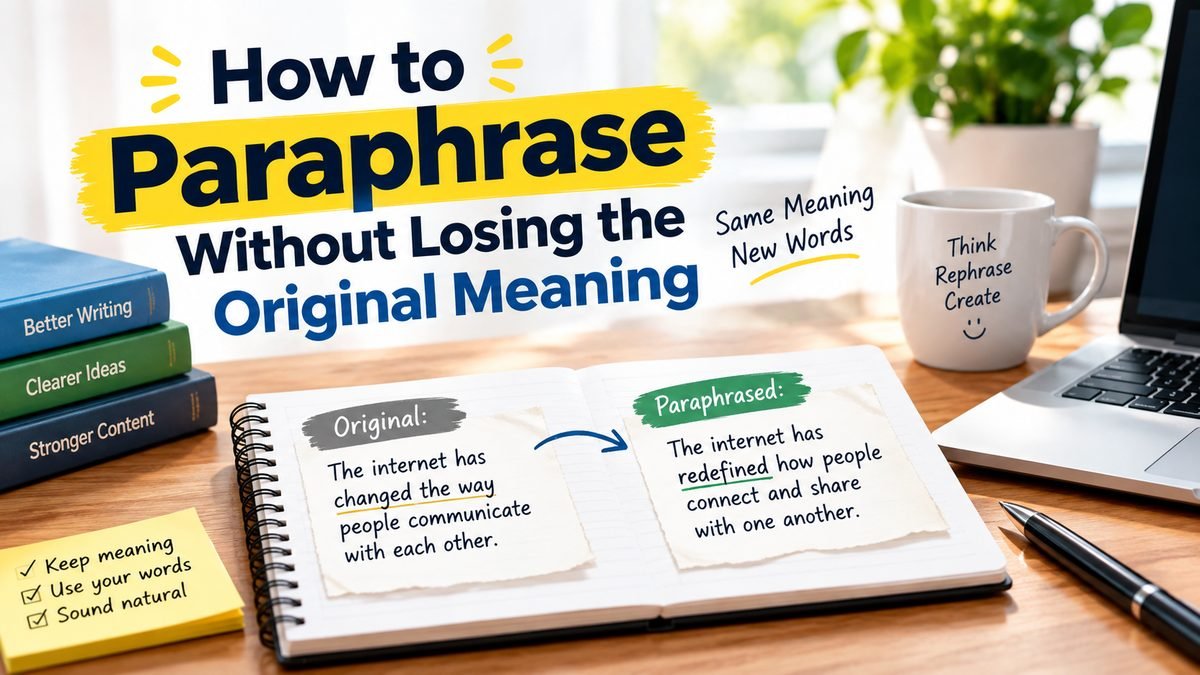
The Ultimate Guide to Paraphrasing: Techniques, Pitfalls, and How to Master Ethical Rewriting
At first glance, paraphrasing appears to be one of the simplest tasks in writing: read a sentence, swap in a few alternate vocabulary words, and rephrase it under your own name. In real-world practice, however, effective paraphrasing is an intellectual discipline that catches millions of students, freelance copywriters, and digital publishers off guard. Most attempts at rewriting either cling so closely to the original phrasing that they trigger plagiarism algorithms, or drift so far from the core premise that the underlying factual accuracy is completely destroyed.
Whether you are an academic researcher crafting a comprehensive literature review, a digital marketer developing SEO content, or a web publisher applying for Google AdSense monetization, mastering the art of authentic paraphrasing is non-negotiable. Paraphrasing is not simply word substitution; it is the process of completely digesting a complex concept and rearticulating it through your own distinct cognitive filter.
In this in-depth guide, we explore the science behind effective paraphrasing, dissect the most common structural mistakes writers make, evaluate the strategic role of modern paraphrasing tools, and supply actionable frameworks to ensure your rewrites remain authentic, accurate, and completely unique.
1. Read for the Core Idea, Not the Surface Wording
The single greatest obstacle to successful paraphrasing is cognitive anchoring. When you keep your eyes glued to a reference text while typing, your brain naturally defaults to the easiest mental path: mirroring the sentence cadence, word order, and linguistic style of the original author.
The Mental Digestion Framework
To break free from subconscious mimicry, you must separate the research phase from the writing phase. Approach source material using the following cognitive process:
- Absorb the full concept: Read the entire passage, paragraph, or research section without touching your keyboard. Focus on uncovering the fundamental message, argument, or thesis rather than individual turns of phrase.
- Break visual contact: Minimize the browser tab, turn over the paper, or close your notes completely.
- Explain it out loud: Ask yourself: "How would I explain this concept to a colleague over coffee in 30 seconds?" Speaking the idea aloud naturally strips away bureaucratic jargon and academic fluff.
- Draft purely from memory: Type out your conceptual understanding in a blank document before glancing back at the original text.
This deliberate workflow forces you to reconstruct the idea using your own cognitive syntax. When you eventually revisit the source document, you are only checking for factual fidelity—not borrowing language.
2. Change the Sentence Architecture, Not Just the Vocabulary
The most pervasive error in modern writing is patchwriting—the practice of taking an author's sentence structure and swapping individual words with arbitrary synonyms found via an online dictionary. Patchwriting produces awkward, unnatural prose, distorts subtle contextual nuances, and consistently gets flagged by modern similarity detection engines like Turnitin and Copyscape.
Strategies for Deep Structural Transformation
Authentic paraphrasing requires transforming the grammatical architecture of the text. Here are four practical techniques to alter sentence mechanics without losing substance:
- Invert the Cause-and-Effect Relationship: If the original sentence starts with a cause and finishes with a result, flip the sequence. Lead with the final consequence and explain the catalyst afterward.
- Split or Consolidate Sentences: Break an overlong, comma-heavy compound sentence into two punchy, clear thoughts. Alternatively, take two fragmented observations and synthesize them into a single, cohesive argument.
- Shift the Grammatical Voice: While active voice is generally preferred in digital publishing, shifting between active and passive constructions—or changing nouns into action verbs—completely rewrites the underlying sentence blueprint.
- Change the Starting Anchor: Never begin your paraphrased sentence with the exact same noun, modifier, or transition word as the source. Anchor your sentence around a completely different conceptual element.
3. Factual Integrity: Protecting Data While Modifying Tone
A well-crafted paraphrase maintains total factual accuracy while sounding as though it originated from an entirely distinct voice. While style and syntax are flexible, facts, empirical data, experimental findings, and quantitative metrics are immutable.
Preventing Semantic Drift
Semantic drift happens when a writer alters phrasing so aggressively that the technical meaning of the sentence changes. Consider how easily meaning can get distorted:
- "The survey suggests a possible correlation between sleep loss and cognitive decline." (Cautious, hypothetical academic stance).
- "The study proves that lack of sleep destroys brain function." (Distorted, exaggerated, and factually incorrect paraphrase).
Notice how modifying modal verbs (from suggests to proves) completely changes the empirical validity of the statement. When rewriting research-heavy or data-driven content, cross-examine every number, date, qualification, and statistical boundary condition against the source material.
4. Practical Examples: Weak Rewrites vs. Professional Paraphrasing
To clearly see the difference between superficial synonym swapping and authentic, professional paraphrasing, study the real-world side-by-side comparisons below:
Example 1: Business and Management Context
Original Excerpt:
"Flexible remote working arrangements have led to a noticeable increase in employee retention rates across mid-sized tech firms over the last three years."
Weak Paraphrase (Patchwriting - Plagiarism Risk):
"Adaptable distant working conditions have caused a visible growth in worker retention numbers across medium tech businesses over the past three years."
(Flaw: Identical rhythm, identical grammatical structure; every word was mechanically substituted with an awkward synonym.)
Strong Paraphrase (Original Synthesis):
"Mid-sized technology companies have experienced significantly lower employee turnover in recent years, largely driven by the adoption of versatile work-from-home policies."
(Success: Completely reorganized sentence structure, clear tone, natural language, and intact factual meaning.)
Example 2: Technical and Digital Publishing Context
Original Excerpt:
"Search engine crawlers deprioritize repetitive, low-value content because algorithmic updates reward web pages offering unique analysis and direct user value."
Strong Paraphrase (Original Synthesis):
"Websites that rely on recycled or superficial articles struggle to rank, as modern search algorithms actively boost resources that provide fresh perspectives and practical solutions."
5. When and How to Leverage Automated Paraphrasing Tools
With the rise of natural language processing platforms and dedicated rewriting tools, writers frequently question whether utilizing software to reword content is acceptable. The answer depends entirely on how you integrate technology into your creative pipeline.
The Safe Role of Rewriting Software
Automated paraphrasing tools can be effective creative sounding boards. They are particularly helpful when you find yourself stuck in a mental rut, staring at a sentence you cannot seem to untangle. Running a clunky paragraph through a tool can provide alternate sentence rhythms and fresh structural perspectives in seconds.
The Critical Dangers of Blind Copy-Pasting
However, treating an automated paraphraser as an autonomous writer is a recipe for disaster:
- Loss of Contextual Precision: Software frequently misunderstands idioms, industry-specific terminology, and subtle humor, outputting bizarre combinations of words that erode your editorial credibility.
- Monotonous Cadence: Automated tools often produce predictable sentence lengths and flat stylistic rhythms that trigger automated AI detection systems.
- Search Engine Rejection: Search algorithms, including Google’s Helpful Content system, are specifically trained to identify programmatic word-spinning. Sites flooded with raw, unedited spun content face manual actions or swift AdSense application denials for "Low Value Content."
The Rule of Thumb: Use paraphrasing software exclusively as a rough first draft. You must read, critique, and manually edit every generated sentence before publication to verify that it aligns with your authentic voice and accurately represents the facts.
6. Paraphrasing vs. Summarizing vs. Direct Quoting
Knowing when to paraphrase is just as vital as knowing how to paraphrase. Writers have three foundational techniques for incorporating external sources into their content:
- Direct Quoting: Use direct quotes sparingly (typically under 5% to 10% of your total text). Direct quotes should be reserved for moments when an authority makes a statement with exceptional linguistic precision, when defining a controversial position, or when presenting historical evidence.
- Paraphrasing: Use paraphrasing when you need to integrate another creator’s detailed technical point, case study, or argument smoothly into your own writing style and flow without relying on disjointed quotation marks.
- Summarizing: Use summarizing when an entire chapter, study, or overarching theory needs to be condensed into a brief, two-sentence takeaway that supports your broader argument.
7. Frequently Asked Questions (FAQs)
Do I still need to cite a source if I completely paraphrased it?
Yes, absolutely. Paraphrasing changes the author's words, but it does not change the origin of the underlying idea. Presenting another person's research, data point, or unique concept without citing them—even if rewritten in entirely new phrasing—remains an intellectual property violation and a form of plagiarism. On blogs, provide a contextual hyperlink; in academia, include an author-date citation.
Is it acceptable to keep specialized technical terms unchanged?
Yes. Specialized vocabulary, clinical terminology, proper nouns, and standard technical identifiers (such as "photosynthesis," "machine learning," or "inflation rate") do not need to be replaced with awkward synonyms. Paraphrasing is about reworking the surrounding arguments and syntax, not mutilating established scientific or technical language.
Can plagiarism detection tools detect paraphrased text?
Advanced similarity engines like Turnitin, Copyscape, and modern search crawlers do not merely search for matching strings of identical words. They analyze linguistic patterns, sentence architecture, and conceptual flow. If your paraphrase merely swaps words while retaining identical structure, it will almost certainly be flagged as patchwriting.
Does ethical paraphrasing help in getting Google AdSense approval?
Yes. Google AdSense policies explicitly demand original, high-value content. Synthesizing external information into original, well-structured, and helpful guides demonstrates expertise and authority, making your site a strong candidate for monetization.
Conclusion
Effective paraphrasing is far more than a cosmetic word swap; it is an active exercise in critical thinking, comprehension, and ethical scholarship. By training yourself to absorb ideas deeply, disconnecting your writing process from source text, and deliberately rearchitecting sentence structures, you transform ordinary research into compelling, authoritative, and original content. In a digital world crowded with duplicate material, mastering this single skill guarantees that your voice stands out with authority, honesty, and lasting influence.