
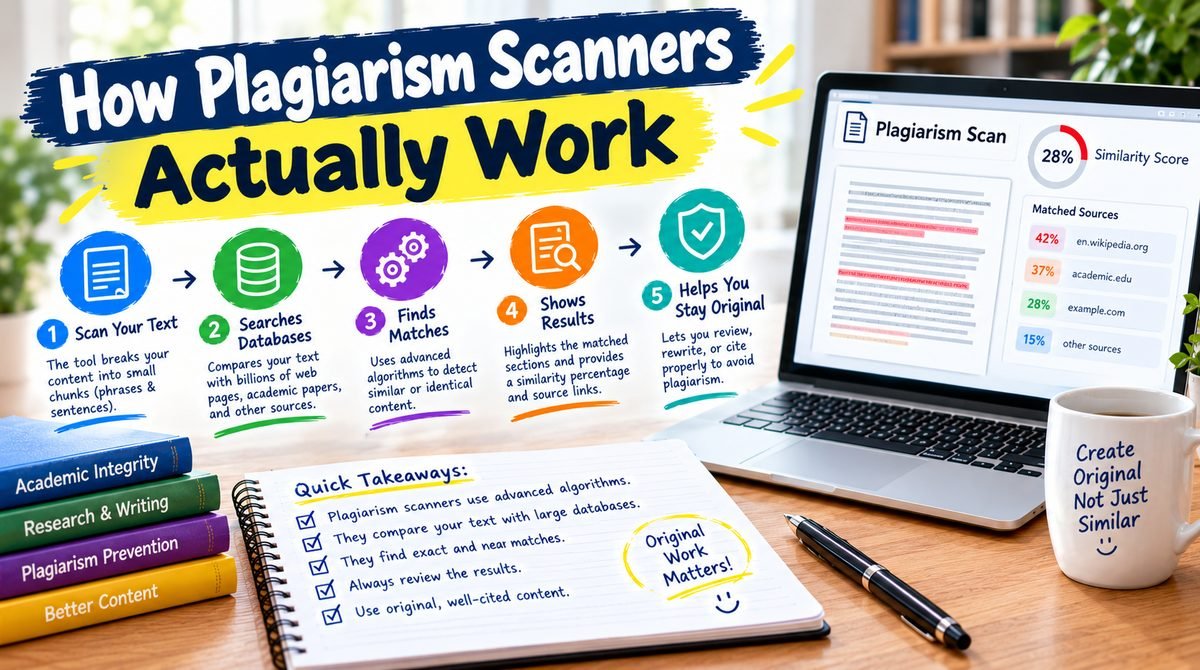
How Plagiarism Scanners Actually Work: Deconstructing Algorithms, Similarity Scores, and the Science of Original Writing
For students, academic researchers, copywriters, and online publishers, submitting a finished manuscript into a plagiarism scanner can feel like a nerve-racking gamble. You upload your document into an interface—such as Turnitin, Copyscape, Grammarly, or Unicheck—wait a few tense moments while a digital progress bar fills, and receive a solitary, unyielding metric: a similarity percentage score.
To many writers, this process feels like submitting their work to an opaque, arbitrary black box. A student might receive an alarming 24% similarity index and panic, assuming they are about to be accused of academic fraud, while a blogger might receive a 3% score and assume their post is guaranteed to rank on Google. In reality, both assumptions misinterpret what the software is actually doing.
Plagiarism detection engines are not sentient arbiters of truth, nor do they possess the human ability to evaluate creative intent. They are mathematical pattern-matching and string-comparison systems operating across colossal databases. Understanding the computer science, algorithms, and linguistic mechanisms driving these tools demystifies the similarity score, eliminates submission anxiety, and teaches you how to structure your writing so that it represents authentic, verifiable originality.
1. They Compare, They Don’t "Know": The Mechanics of Text Matching
The fundamental premise to understand about any plagiarism scanner is that it does not read or comprehend your writing the way a human being does. A software scanner has no grasp of narrative nuance, context, or critical analysis; it executes computational comparisons between text sequences.
Tokenization and N-Gram Shingling
When you upload a manuscript, the software’s parsing engine strips away styling, normalizes capitalization, and breaks your sentences down into small, overlapping linguistic units known as n-grams (or word shingles).
- An n-gram is a contiguous sequence of n items from a given sample of text.
- For example, in a 5-gram system, the sentence "Climate change impacts coastal agricultural economies" is broken into overlapping five-word strings.
The scanner then converts these text fragments into mathematical fingerprints using cryptographic hashing algorithms. By comparing these hashes against a massive central index, the software can evaluate millions of potential matches in fractions of a second.
The Massive Databases Behind the Scanners
A plagiarism engine is only as effective as the repository it compares your document against. Enterprise-grade scanners cross-reference your paper against three massive data silos:
- The Public Live Web: Billions of indexed web pages, including blogs, news outlets, Wikipedia, digital encyclopedias, and online forums.
- Proprietary Academic Repositories: Exclusive access to paywalled scientific journals, conference proceedings, and research databases (such as Crossref, ProQuest, IEEE, and Elsevier).
- Institutional Student Archives: Millions of previous essays, dissertations, and assignments submitted by students across thousands of universities worldwide over the past two decades.
2. What Actually Counts as a "Match"? (Beyond Direct Copy-Pasting)
Many writers mistakenly believe that as long as they do not copy-paste complete paragraphs word-for-word, a scanner will give them a 0% match. This demonstrates a fundamental misunderstanding of modern matching algorithms.
Fuzzy Matching and Sequence Alignment
Early plagiarism checkers in the 1990s relied on exact string matching. If a single word was altered, the match broke. Modern scanners, however, utilize sophisticated string alignment algorithms (similar to those used in computational biology to compare DNA sequences) and fuzzy matching logic.
These algorithms identify matching sequences even when:
- Words have been inserted or deleted mid-sentence.
- Grammatical clauses have been rearranged.
- Individual words have been swapped for basic dictionary synonyms.
Why Cosmetic Word Swapping (Patchwriting) Always Gets Flagged
When a writer takes an author's sentence and merely replaces every third word with a synonym from a thesaurus, the underlying syntactic dependency, grammatical cadence, and word order remain virtually identical. Plagiarism scanners flag these instances as patchwriting because the mathematical structure of the sentence mirrors the source document too closely to be a coincidence.
3. Why the Similarity Percentage Isn't the Whole Story
One of the most damaging misconceptions in academic and professional writing is conflating a Similarity Score with a Plagiarism Score. They are fundamentally different concepts.
A similarity index is purely a quantitative measurement: it shows what percentage of your document’s text matches text found elsewhere in the scanner's database. Plagiarism, however, is a qualitative, ethical evaluation: it asks whether the matching material represents uncredited, deceptive intellectual theft.
The Sources of Benign Matches
A thoroughly researched, ethically unimpeachable paper can easily generate a 15% to 20% similarity score due to standard, legitimate academic writing components:
- Properly Cited Direct Quotations: If you quote an authoritative expert and enclose the text in quotation marks with a clear citation, the scanner still highlights the phrase as a match unless the reviewer manually filters out quotes.
- Standardized Bibliographic Citations: Journal titles, book citations, and formatting boilerplate in your "Works Cited" page match millions of other published reference lists.
- Disciplinary Terminology and Common Knowledge: Specific scientific names, legal statutes, clinical phrases (e.g., "randomized double-blind placebo-controlled trial"), or historical definitions naturally trigger matching algorithms because they cannot be phrased differently.
The Golden Takeaway: Context matters vastly more than the raw number. An instructor or editor who understands how scanners work will inspect the highlighted passages individually to see what is matching, rather than arbitrarily grading based on the percentage alone.
4. Understanding the Similarity Index Spectrum
While every university department and editorial house maintains its own thresholds, similarity reports generally fall into the following interpretive tiers:
| Similarity Range | Typical Cause in Well-Researched Work | Required Action / Evaluation |
|---|---|---|
| 0% to 5% | Minimal quotes, mostly original synthesis or purely creative reflection. | Check to ensure you didn't forget to cite external data sources. Exceptionally rare in literature-heavy research. |
| 6% to 15% | Standard academic research with proper direct quotes, references, and disciplinary terms. | The ideal sweet spot for most academic research papers and authoritative blog posts. |
| 16% to 25% | High density of direct quotes, lengthy reference section, or common terminology. | Review the report: ensure quoted passages have quotation marks and are not substituting for your own analysis. |
| 26% and Above | Substantial overlapping paragraphs, extensive patchwriting, or unquoted source blocks. | High risk of academic misconduct or AdSense "Thin/Scraped Content" rejection. Deep structural revision required. |
5. What This Means for How You Write: The Architectural Approach
Knowing that scanners analyze syntactic patterns and n-gram shingles transforms how you should approach research and drafting. To produce genuinely unique content that easily passes algorithmic scrutiny, adopt an architectural writing strategy:
1. Practice Cognitive Synthesis, Not Synoptic Editing
Never draft a paragraph while keeping your eyes fixed on an open source document. Read the reference material, understand the core argument, close the tab, and write your explanation entirely from memory. When you recreate a concept using your own cognitive vocabulary, your sentence rhythm and n-gram combinations will naturally be distinct.
2. Transform the Grammatical Architecture
If you need to paraphrase complex data, do not perform a cosmetic word swap. Dismantle the sentence down to its raw facts and rebuild it:
- Change the grammatical subject of the clause.
- Convert compound sentences into clear, separate arguments.
- Invert the order of conditions and consequences.
3. Use Quotation Marks Deliberately
When an author's exact words are so powerful or technically precise that rewriting them degrades their meaning, enclose them in quotation marks immediately. Modern scanners allow instructors to toggle an "Exclude Quotes" filter, which cleanly removes properly formatted quotations from your similarity calculation.
6. Frequently Asked Questions (FAQs)
Can a paper realistically have a 0% similarity score?
In research-heavy disciplines, a 0% score is remarkably rare and sometimes triggers suspicion. If a 15-page research paper displays 0% similarity, it often suggests that the student failed to engage with scholarly literature, cited zero empirical studies, or attempted to circumvent the scanner using technical formatting tricks (like hidden white characters).
Do Google's search algorithms work the same way as Turnitin?
While Google uses similar n-gram analysis and vector embeddings to detect duplicate and scraped content, its objective is different. Turnitin searches for academic misconduct; Google searches for user value and search intent fulfillment. Google filters out duplicate content to ensure search engine results pages do not present identical answers, deprioritizing unoriginal blogs under its Helpful Content System.
How do modern plagiarism scanners detect AI-generated text?
Traditional plagiarism checking looks for direct database matches. AI detection, however, analyzes perplexity (the predictability of word choices) and burstiness (variation in sentence length and structure). AI models produce text with statistically uniform sentence lengths and predictable word sequences, which dedicated AI classifiers detect through probability scoring.
Conclusion
Plagiarism scanners are neither infallible judges nor malicious hurdles; they are sophisticated computational tools reflecting mathematical probabilities. A high similarity score is not an automatic guilty verdict, just as a low score is not proof of intellectual brilliance. By understanding how tokenization, n-grams, and matching algorithms operate, you can strip away the anxiety of the unknown, move beyond lazy synonym swapping, and cultivate a disciplined writing process built on genuine conceptual synthesis and transparent attribution.