
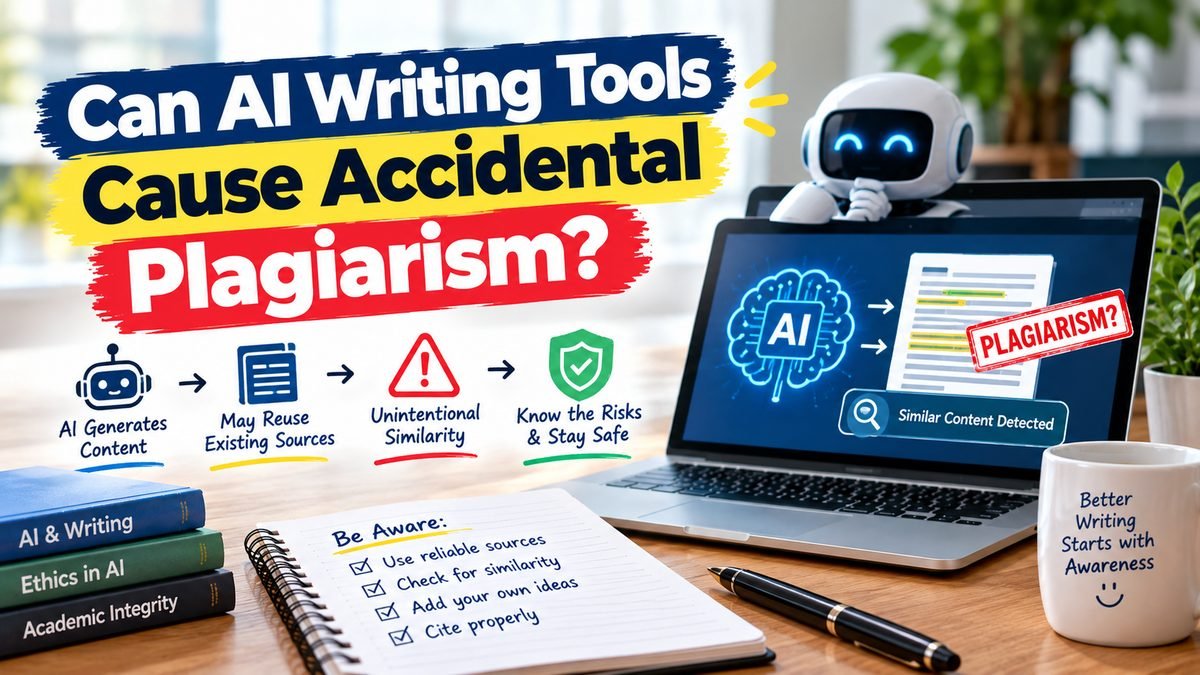
Does AI-Generated Text Count as Plagiarism? The Definitive Guide to Ethics, Algorithms, and Best Practices
The rapid rise of Generative Artificial Intelligence (AI) platforms—such as OpenAI's ChatGPT, Google's Gemini, and Anthropic's Claude—has fundamentally transformed the digital writing landscape. Tasks that previously required days of painstaking research and structural drafting can now be completed in a matter of seconds. Writers, students, and digital marketers routinely deploy AI assistants to outline essays, overcome creative roadblocks, draft email sequences, and generate entire web pages.
However, this unprecedented technological shift has introduced a major ethical and technical dilemma: can text generated by an artificial intelligence model count as plagiarism?
The honest, nuanced answer is: sometimes, yes. While an AI does not browse the internet, hit Ctrl+C, and maliciously paste another author's work, the mathematical architecture behind Large Language Models (LLMs) frequently causes overlapping phrasing, structural mirroring, and attribution failures. Furthermore, academic review boards, editorial publishers, and search engine crawlers evaluate duplicate text based on measurable similarity, not psychological intent.
Whether you are an academic researcher, an independent freelancer, or a web publisher seeking Google AdSense monetization, understanding the intricate intersection of artificial intelligence and plagiarism is vital. This comprehensive guide breaks down how AI regurgitation occurs, contrasts synthetic text with traditional plagiarism, examines search engine policies, and outlines an actionable protocol for using AI safely, ethically, and effectively.
1. How It Happens: Probabilistic Tokens vs. Algorithmic Regurgitation
To understand why AI output can trigger plagiarism detectors, one must understand how modern language models generate language. LLMs do not possess human cognition, understanding, or consciousness; they are sophisticated predictive engines trained on petabytes of digitized books, articles, code repositories, and web pages.
Predictive Token Modeling
When you provide a prompt to an AI model, it does not retrieve a stored document from a filing cabinet. Instead, it calculates probabilities to determine which word (or "token") is most statistically likely to follow the preceding word. On niche, creative, or speculative topics, this predictive process generates unique, previously unseen combinations of language.
The Trap of High-Frequency Common Phrasing
On common, heavily documented topics—such as historical biographies, scientific definitions, standard coding algorithms, or basic marketing playbooks—the training data contains tens of thousands of sentences structured in nearly identical ways. When generating content for these subjects, the algorithm repeatedly selects the most statistically dominant word combinations.
The result? The AI produces a sentence that closely mirrors existing copyrighted articles or academic publications, not because it stole the passage intentionally, but because that specific sequence of words represents the most probable mathematical path. To an automated plagiarism checker, this statistical overlap looks identical to traditional copying.
Model Memorization
Computer science researchers have identified a phenomenon known as model memorization. When an AI model is trained on a passage that appears repeatedly across hundreds of sources (such as legal terms, famous historical speeches, or widely syndicated corporate press releases), the model may memorize the excerpt verbatim. Under specific prompting conditions, the AI will regurgitate the exact source text word-for-word without quotation marks or attribution.
2. AI Overlap vs. Citation Problems: Intent Does Not Matter
In classical literature and academia, plagiarism is treated as an ethical violation of personal integrity. If a student forgets to cite an author, academic boards evaluate whether the omission was a minor formatting error or a deliberate attempt to deceive.
With generative AI, the dynamics change entirely:
- Lack of Human Intent: When an AI outputs a sentence that mirrors an online article, the human user rarely knows the overlap exists. The user did not read the original source, absorb its language, or choose to copy it.
- Algorithmic Scanners Ignore Intent: Enterprise similarity scanners—such as Turnitin, Copyscape, and iThenticate—do not analyze human motives. They compare character sequences, ngram patterns, and syntactic dependencies against billions of indexed pages. If the similarity threshold is breached, the document is flagged for plagiarism, regardless of whether a human, an AI, or pure coincidence produced it.
- Intellectual Misrepresentation: In academic contexts, submitting raw AI text as your own intellectual labor violates institutional honor codes. Even if the AI generated mathematically unique phrasing, claiming that machine-generated ideas reflect your original analysis constitutes a fundamental breach of academic honesty.
3. Hallucinations and the Danger of Fabricated Citations
A secondary plagiarism trap unique to artificial intelligence is AI hallucination. When users ask an AI model to write a research-heavy article and demand formal citations, the model aims to satisfy the prompt using probabilistic text generation.
Rather than pulling real publications from verified academic repositories, language models frequently invent:
- Fictitious author names paired with real academic journals.
- Non-existent Digital Object Identifiers (DOIs) and publication years.
- Fabricated statistics attributed to prestigious institutions (e.g., falsely claiming that "According to a 2023 Harvard study...").
Submitting an article with fabricated references falls directly under source-based plagiarism and academic fraud. Fact-checkers, university professors, and editorial clients verify citations immediately; presenting a fictional study destroys professional credibility in seconds.
4. Google's Stance and the Impact on SEO and AdSense Approval
For bloggers and digital publishers, the relationship between AI content, plagiarism, and monetization is a frequent source of anxiety. Google has provided explicit public guidance regarding how search crawlers evaluate automated text.
Quality Over Production Method
Google’s official policy states that using AI to generate content is not inherently against search guidelines. Search algorithms do not care whether an article was typed by a human, produced by an AI, or created through a hybrid collaboration. What search algorithms do care about is user value, originality, and adherence to the E-E-A-T (Experience, Expertise, Authoritativeness, Trustworthiness) framework.
Why Raw AI Content Fails Google AdSense Reviews
Despite Google’s openness to AI tools, hundreds of thousands of blog owners face immediate AdSense rejections with notices stating "Low Value Content" or "Scraped Content." Why does this happen?
- Lack of First-Hand Experience: AI models cannot test a physical product, visit a restaurant, conduct an empirical interview, or experience human emotion. Raw AI content reads as generic, passive, and derivative.
- Formulaic Sentence Rhythm: Unedited AI writing relies on predictable transition words (e.g., "Moreover," "In conclusion," "It is important to remember") and balanced compound sentences that algorithmic filters easily categorize as low-effort mass production.
- Helpful Content System Penalties: Google’s ranking systems are designed to deprioritize web pages that merely synthesize what five other high-ranking blogs have already published. If your AI article adds zero proprietary research, unique commentary, or original data, it provides no user utility and will struggle to qualify for monetization.
5. A 5-Step Protocol Before Submitting AI-Assisted Writing
You do not need to abandon AI tools entirely; you simply need to manage them with editorial rigor. Follow this professional five-step protocol to safeguard your work against plagiarism and originality penalties:
Step 1: Treat AI Output as a Rough First Draft
Never treat the initial response of an AI prompt as a finished deliverable. View the AI as an intern who provided an unverified rough outline. Your job as the senior editor is to critique, restructure, trim, and polish every single paragraph.
Step 2: Inject Your Unique Human Voice and Anecdotes
Strip out generic, repetitive AI terminology. Rewrite key sections using your natural conversational cadence, personal observations, industry-specific anecdotes, and real-world case studies. Human experiences cannot be replicated by predictive algorithms.
Step 3: Manually Fact-Check Every Statistic and Claim
Assume every statistic, date, and external claim generated by an AI is incorrect until proven otherwise. Open a primary search window, locate the original publication, confirm the numerical data, and insert a legitimate contextual hyperlink or academic reference.
Step 4: Conduct a Rigorous Pre-Submission Similarity Scan
Before submitting an assignment or publishing a blog post, run your finished draft through a trusted plagiarism checker such as Copyscape, Grammarly, or Turnitin. If any sentence matches an external source by more than a few words, manually rewrite the syntax or apply quotation marks.
Step 5: Review Institutional and Publisher AI Disclosure Policies
Transparency is your strongest legal and ethical shield. Educational institutions, corporate marketing departments, and scientific journals maintain widely differing rules on AI disclosure. Some require a formal methodology note detailing which models were used, while others prohibit synthetic assistance altogether. Know your publication's specific guidelines before submission.
6. Frequently Asked Questions (FAQs)
Can plagiarism scanners detect text written by an AI?
Standard plagiarism scanners look for matches against indexed databases, meaning they only flag AI text if it statistically mirrors an existing publication. However, dedicated AI detectors (such as Turnitin's AI Writing Indicator or Copyleaks) evaluate perplexity and burstiness (the randomness and structural variation of text) to determine whether a passage was synthetically generated.
Will Google AdSense ban my website for using AI-assisted content?
No, AdSense does not penalize sites merely for utilizing AI writing software. However, AdSense strictly rejects websites that publish low-effort, thin, or repetitive AI content that provides no genuine value to readers. If you heavily edit the text, add personal insights, and ensure comprehensive quality, your site can be approved.
Is it safe to use AI for proofreading and grammatical corrections?
Yes. Utilizing AI for spelling corrections, syntactic polishing, and punctuation fixes is broadly accepted across modern academic and professional standards, much like traditional spellcheckers. It improves readability without altering your original ideas or authorship.
Conclusion
Artificial intelligence is neither an automatic fast-track to plagiarism nor a flawless substitute for human intellect. It is a powerful assistive instrument. When creators rely on language models to do their thinking for them, they invite structural mirroring, duplicate phrasing, hallucinated facts, and severe credibility damage. However, when you treat AI output as an initial brainstorming partner—subjecting every sentence to human scrutiny, manual verification, and thoughtful rewriting—you can dramatically accelerate your productivity while keeping your writing authentic, ethical, and 100% original.